A collaboration with Gary, Port Festival 2009
‘England is a supposed model of democracy and justice, yet ironically I have so far been made to serve longer for being rebellious and non-conformist than the Yorkshire Ripper has for 13 serial killings. Nowadays, painting is the only thing that keeps me alive.’ Gary, 2009.
In around 2007, Gary and I agreed that we would work together on a letter exchange project.
The process involved asking difficult questions about life, imprisonment and death (not necessarily in that order), exploring the linear value of our daily lives and relating our personal histories. Inevitably due to the process and social distance, questions were left unanswered, issues unresolved and emotions left hanging.
Orisanmi Burton describes this epistolary method as:
‘a form of community building, grassroots intelligence gathering, collective theorization, and mutual aid…The slow and deliberate act of producing, circulating, and consuming letters is a contemplative practice generated from mutual investments of time, as well as emotional and intellectual labor, that has far-reaching effects.’
This particular project didn’t answer many grand questions but it was nevertheless an attempt at looking at how communication between two people could imagine a vision of the world.
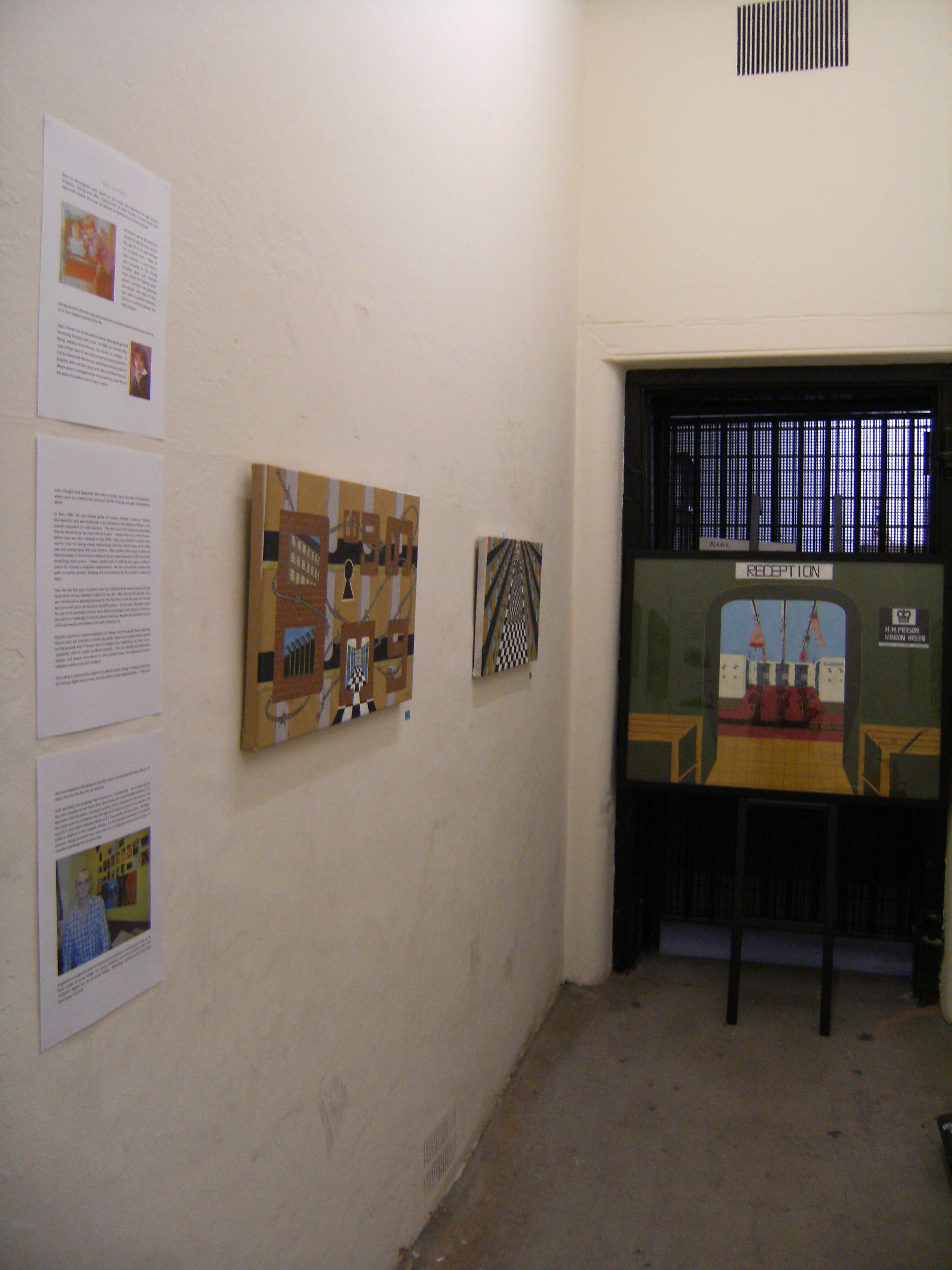
Artwork was created by both artists in response to this process and exhibited at 2 sites (the old police cells and a vacant shop front) in Port Adelaide during the 2009 Port Festival.
Below are some comments left by visitors.
Thank you both for an insightful and important dialogue on an issue that is so overlooked and in need of such public scrutiny. As artists you are both inspiring.
A very disturbing and thought provoking exhibition, illuminating aspects of a ‘justice’ system that are shocking and ‘unpalatable’ to say the least.
It is really disturbing to see how clearly how powerless the individual can become once contained in the “justice’ system! Thought provoking!!
Political, challenging, expressed with beautifully executed objects.
Seeing these paintings in the confines of a gaol makes the perspective of the subject come to life – as the viewer (me) struggles to put them in the line of (confined) sight.
Below is a sample of Gary’s work.


The video below is my response and use of Gary’s case notes (with permission), detailing official objections to and dismissals of Gary’s worthiness as a human being. It was installed in one of the old police cells.
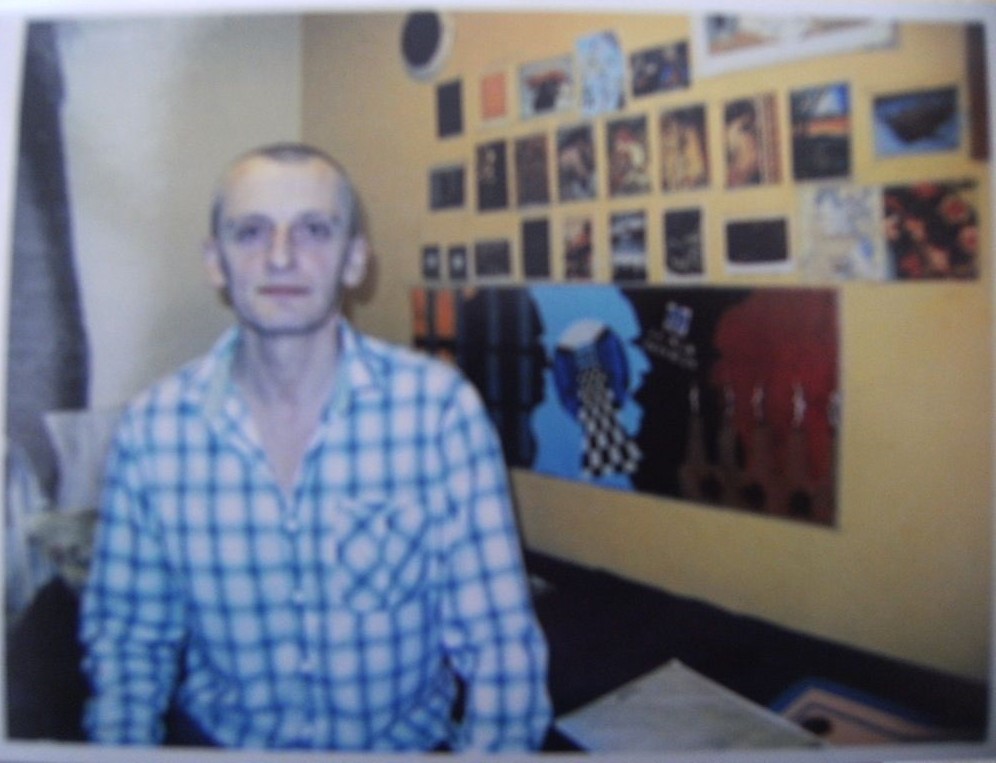
You can read Gary’s biography, written by himself, below.
Born in Birmingham and raised on an estate which bordered on two mental hospitals, visiting and often staying with his elder brother in care homes and approved schools, Gary was introduced to institutions at a very early age.

At 8 years old he got drunk on alcohol for the first time and by the age of 12 he was drinking on a regular basis. Aged 14 Gary became a punk rocker and was recruited to the Young Socialist party and he was excluded from school for leading ‘pupil-power’ marches and picketing the school. Also aged 14 Gary was sent to juvenile detention centre for criminal damage and theft charges.
During his time there he was physically and mentally abused and he describes this as a very negative period of his life. Upon release he quickly deteriorated, abusing drugs and becoming involved with crime. In 1980, six months after being released from borstal, he moved to London. In June of that year he was discovered severely injured four stories below the flat he was squatting and was taken to hospital with a broken back, arm, legs and head injuries. When police investigated the circumstances, they found the body of another man in Gary’s squat.
Later charged and bailed for this man’s murder, Gary returned to Birmingham where even on crutches he continued his life of punk rock gigs and substance abuse.
In May 1981, he was found guilty of murder (despite numerous forensic discrepancies) and was sentenced to be ‘detained at Her Majesty’s Pleasure’, the juvenile equivalent of a life sentence. The then Lord Chief Justice recommended that he should serve ‘no more that 8-9 years’. Despite this it was a full 20 years before Gary was first released in July 2000. Gary was recalled to prison three months later for having sexual relationships with two female peers at his rehab unit and running away with one of them. After another three years in prison for these breaches of his license-conditions, he was again released in 2003 to another drink/drug rehab centre. Twelve months later in 2004 he was again recalled to prison for missing a probation appointment. He has since served another five years in various prisons, bringing the total amount he has served to almost 30 years.
Over the last five years in prison, Gary has suffered from severe depression and made three serious attempts to take his own life. After the second attempt, Gary was introduced to drawing/painting for the first time in his life and over the last two and a half years has become a prolific painter. He has won a Koestler award for one of his paintings and has been both encouraged and inspired to paint by the staff of a Cambridge University library that have bought and exhibited several of his early works and sponsor him with materials etc.
Despite unanimous recommendations of release and the parole board agreeing that he does not constitute a risk to the public, Gary was recently refused parole on the grounds that if he was ever to relapse into drink/drug use there was a “possibility” that he “could” re-offend violently. This was despite all professional opinion and masses of evidence to the contrary (Gary has long experienced addiction without any such incident).
This ruling is currently the subject of a judicial review, being in breach of not only the Human Rights Act but also several judicial rulings regarding Lifers. There are also investigations still going on into the events surrounding the index offence, of which Gary to this day has no memory.
Gary describes his on-going imprisonment as “warehousing”. At 47 years old he has now actually served more than three times the recommended sentence. He maintains that he never murdered anyone, never intended to hurt anyone and has never prior to or indeed since the age of 17 been involved in any violence. He says he is now semi-institutionalised and a true product of the system. No longer jailed in relation to the original offence, he has become somewhat of a political prisoner: being punished over and over by a retributive system for his years of rebellion and breaches of petty rules.
 the quiet room